
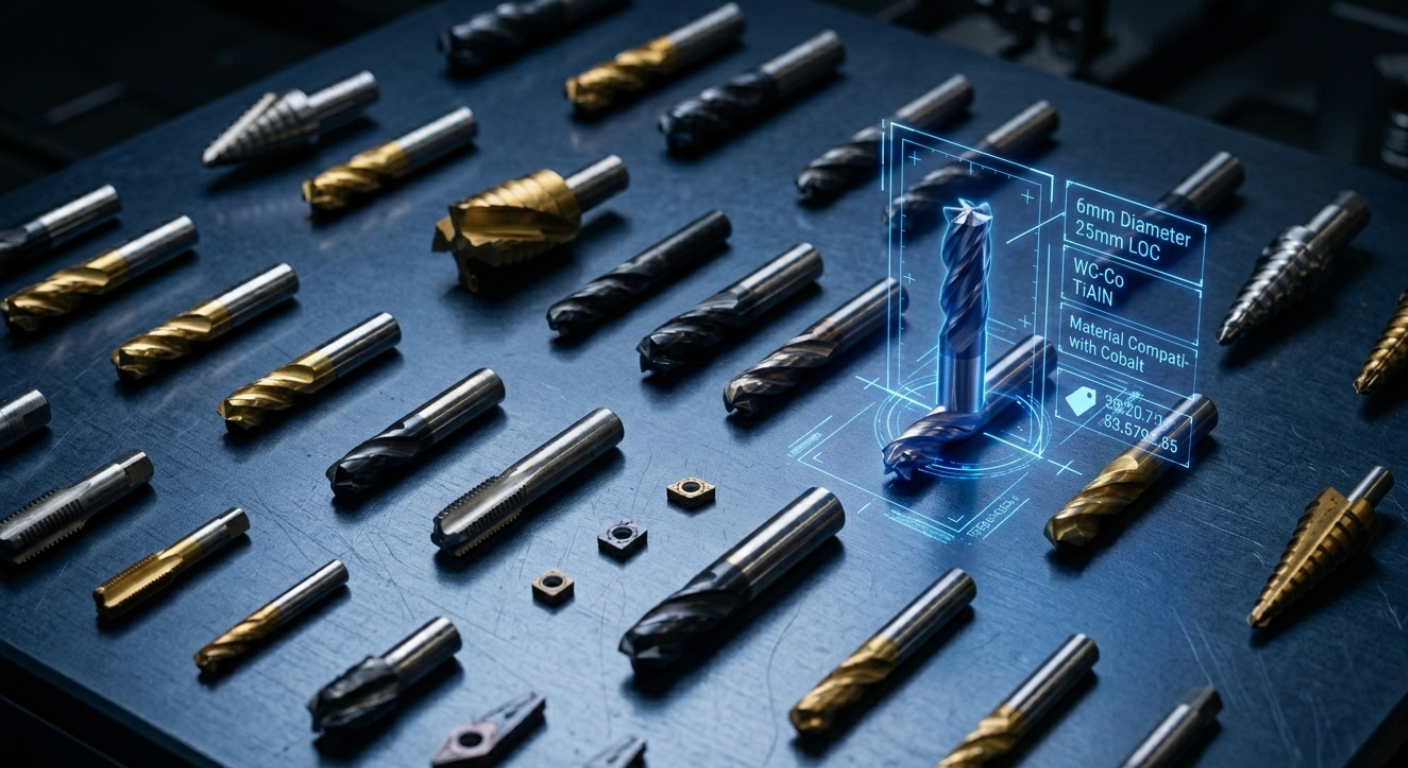
Featured Image Prompt: A dramatic close-up of precision CNC cutting tools (end mills, drills, inserts) arranged in a clean grid pattern on a dark metallic surface. One tool is highlighted with a subtle blue digital overlay showing dimensions, specifications, and a price tag. Moody industrial lighting, sharp detail, product photography meets tech aesthetic.
The CNC tooling industry is built on precision. Micron-level tolerances, exotic material grades, and complex geometries are standard. Yet when it comes to quoting these intricate products, many manufacturers still rely on processes that would be considered primitive on the shop floor.
The gap between manufacturing sophistication and quoting sophistication is where revenue leaks. And CNC tooling manufacturers who close that gap with CPQ are seeing measurable results.
The unique quoting challenge in CNC tooling
CNC tooling isn't like quoting commodity products. A single cutting tool can have dozens of configurable parameters:
- Geometry - diameter, flute count, helix angle, corner radius, overall length
- Material - solid carbide, HSS, cermet, PCD, CBN
- Coating - TiAlN, AlCrN, TiSiN, DLC, uncoated
- Tolerance class - h5, h6, h7, or tighter
- Shank type - cylindrical, Weldon flat, HA, HSK
- Application - roughing, finishing, high-speed, hardened steel, aluminium
Each combination affects cost differently. A PCD-tipped tool with h5 tolerance requires different machine time, different raw material, and different quality processes than a standard carbide end mill.
"In tooling, the number of valid product configurations can run into the millions. Traditional quoting methods simply cannot keep up with this level of complexity while maintaining accuracy." - Dr. Fritz Klocke, Former Head of the Laboratory for Machine Tools and Production Engineering, RWTH Aachen
How CPQ solves tooling-specific problems
Rules-driven configuration eliminates errors
A CPQ configurator enforces manufacturing constraints at the point of selection. If a customer selects a 0.5mm diameter end mill with 6 flutes, the system flags that as infeasible. If someone requests a DLC coating on a tool that will operate above 400C, the configurator suggests alternatives.
This validation happens instantly, preventing configurations that would otherwise require engineering review - or worse, reach the shop floor before someone catches the mistake.
Cost-driven pricing replaces guesswork
Instead of looking up a price in a static table, CPQ calculates from first principles:
- Raw material cost based on bar diameter and length, at current market rates
- Machine time per operation (grinding, EDM, inspection) based on tool geometry
- Coating cost per batch, amortised across the order quantity
- Quality and certification costs for the specified tolerance class
- Packaging and logistics for the required delivery method
"When we moved from price lists to cost-driven quoting, our average margin improved by 4.2% within the first quarter. We were underpricing complex tools and overpricing simple ones without realising it." - Commercial Director, European tooling manufacturer
Visual configuration builds customer confidence
Modern CPQ platforms can generate 2D parametric drawings or 3D previews that update in real time as the customer configures their tool. For CNC tooling, where geometry is everything, this visual confirmation dramatically reduces specification errors and speeds up the approval cycle.
Real results from the tooling industry
Tooling manufacturers implementing CPQ are reporting consistent improvements:
- Quote turnaround reduced from 3-5 days to under 2 hours for standard and semi-custom tools
- Win rates improved by 18-25% primarily due to faster response times
- Configuration errors dropped by 90%+ with rules-driven validation
- New sales reps productive in weeks rather than months because product knowledge is embedded in the system
"We used to lose quotes simply because we were too slow. Now we can turn around a complex special tool quote in 90 minutes. Our competitors are still calculating by hand." - Sales Manager, Precision tooling manufacturer
The competitive advantage compounds
Speed and accuracy in quoting create a flywheel effect:
- Faster quotes mean more quotes sent per week
- More quotes mean more opportunities in the pipeline
- Better accuracy means fewer margin-eroding errors
- Higher win rates mean more revenue from the same sales effort
- Centralised data enables better pricing strategy over time
Each improvement feeds the next. The manufacturers who adopt CPQ early don't just catch up - they pull ahead.
What to look for in a tooling CPQ
Not every CPQ platform is suitable for CNC tooling. The right solution should:
- Understand manufacturing constraints - not just option dependencies
- Calculate costs from first principles - material, machine time, labour, overhead
- Support parametric configuration - dimensions and specifications, not just option lists
- Integrate with your systems - ERP for costs, PLM for product data, CRM for customer pricing
- Generate professional outputs - PDF quotes, technical drawings, and order confirmations
Getting started
The most effective approach is to start with your highest-volume product family. Configure the rules, validate the pricing against historical quotes, and run both systems in parallel for 2-4 weeks. The speed and accuracy gains will make the business case self-evident.
Kabaido's CPQ platform is designed for precision tooling manufacturers. Configure complex cutting tools, calculate dynamic prices, and generate professional quotes in minutes. Explore the platform or start today.