
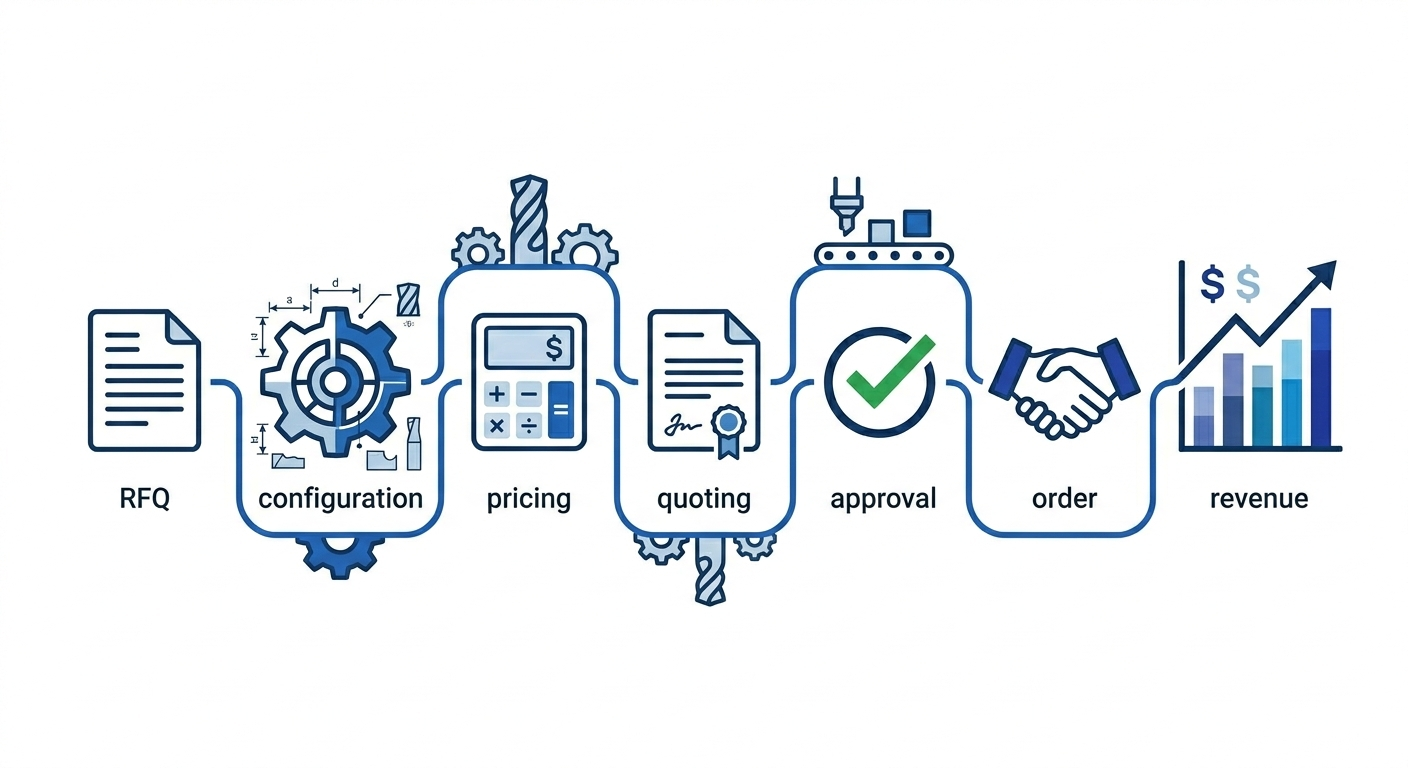
Featured Image Prompt: An abstract, clean infographic-style illustration showing a horizontal timeline flowing left to right. On the left, a document icon labeled "RFQ" transforms through stages - configuration (gear icon), pricing (calculator icon), quoting (document icon), approval (checkmark), and order (handshake) - ending with a revenue chart trending upward on the right. Connected by a flowing blue line with subtle manufacturing motifs. White background, flat design, corporate but modern.
In manufacturing, the distance between receiving an RFQ and depositing revenue is measured in weeks - sometimes months. Every day in that cycle represents tied-up resources, uncertain forecasting, and the ever-present risk that the customer finds a faster alternative.
The quote-to-cash cycle encompasses everything from initial enquiry to payment receipt. And for most manufacturers, it's full of delays that are entirely preventable.
Anatomy of a slow quote-to-cash cycle
Here's what a typical cycle looks like for a precision manufacturer:
| Stage | Typical Duration | Common Delays |
|---|---|---|
| RFQ receipt and review | 1-2 days | Manual email triage, unclear requirements |
| Technical feasibility | 1-3 days | Engineering backlog, information gaps |
| Cost estimation | 1-3 days | Manual calculation, material price lookups |
| Quote preparation | 1-2 days | Formatting, internal review, approval |
| Customer review | 3-7 days | Revisions, negotiations, decision committee |
| Order processing | 1-2 days | Manual order entry, credit checks |
| Total | 8-20 days |
"The average B2B manufacturing quote-to-cash cycle takes 30-45 days from RFQ to payment. Companies that reduce this to under 20 days see 23% higher revenue growth than their peers." - Bain & Company, Manufacturing Sales Excellence Report
That's 8-20 days just to convert a quote into an order - before manufacturing even starts. And each stage has friction points that compound into significant revenue delays.
Where the time actually goes
The inbox problem
RFQs arrive via email, phone, web forms, and occasionally fax. Without automated intake, someone has to read each one, determine what's being requested, and route it to the right person. This triage step alone can add 24-48 hours.
The estimation bottleneck
Cost estimation in manufacturing requires specialised knowledge. Most companies have 1-3 people who can estimate accurately, and they're usually also involved in production. Their estimating work gets squeezed into gaps between operational responsibilities.
The approval loop
Internal approvals - especially for non-standard pricing or high-value quotes - can add days. The approver is in a meeting, on the shop floor, or reviewing other priorities. Meanwhile, the clock is ticking.
The revision cycle
First quotes are rarely final quotes. Customer negotiations, specification changes, and quantity adjustments create revision cycles that can double the time from initial quote to accepted order.
"We tracked our quoting process and found that the average quote went through 2.3 revisions before acceptance. Each revision added 2-3 days to the cycle. Reducing revision cycles had a bigger impact on our turnaround than any other single improvement." - VP Sales, Industrial components manufacturer
How manufacturers are compressing the cycle
Automated RFQ intake
CPQ platforms with email integration automatically extract requirements from incoming RFQs, classify them by product type and urgency, and create structured records. What used to take a person 30 minutes takes the system 30 seconds.
Parallel processing
Instead of sequential handoffs (sales to engineering to estimating to management), modern CPQ enables parallel workflows:
- Standard products are auto-quoted without engineering involvement
- Semi-custom products get engineering review while cost estimation runs simultaneously
- Approval workflows trigger automatically based on value and margin thresholds
Self-service quoting portals
For repeat customers ordering standard or semi-custom products, self-service portals eliminate the entire sales-mediated quoting step. Customers configure products, see real-time pricing, and place orders directly - 24/7, without waiting for business hours.
"Our customer portal now handles 35% of our total quote volume. These quotes close in an average of 2 days compared to 12 days for manually processed quotes. And we haven't added a single headcount." - Digital Transformation Director, Tooling manufacturer
Intelligent revision management
CPQ systems that track quote versions and customer interactions can predict which quotes are likely to require revision and pre-empt the cycle. If historical data shows that a particular customer always negotiates 5% off initial pricing, the system can account for this in the initial margin target.
Building a faster quote-to-cash process
Phase 1: Digitise and measure
Before optimising, you need visibility. Track:
- Time from RFQ receipt to quote sent
- Number of revisions per quote
- Time from quote accepted to order entered
- Overall cycle time from RFQ to payment
You can't improve what you don't measure.
Phase 2: Eliminate manual handoffs
Every time a quote moves from one person's desk to another, it waits. Map your current process and identify every handoff point. Then ask: can this handoff be automated, eliminated, or run in parallel?
Phase 3: Implement CPQ
A proper CPQ system addresses the majority of cycle time waste:
- Automated intake eliminates triage delays
- Rules-driven configuration eliminates engineering review for standard products
- Dynamic pricing eliminates manual cost calculation
- Approval workflows eliminate email-based approval chains
- Professional output generation eliminates manual formatting
Phase 4: Extend to order management
The quote-to-cash cycle doesn't end when the quote is accepted. Connect your CPQ to order management and ERP systems so accepted quotes flow automatically into production orders, reducing another 1-2 days of manual processing.
The revenue impact
Compressing the quote-to-cash cycle has a direct, measurable impact on revenue:
- More quotes per period - Faster processing means higher capacity
- Higher win rates - Speed correlates strongly with conversion
- Faster cash collection - Shorter cycles mean earlier invoicing
- Better forecasting - Visible pipeline with predictable stage durations
"Reducing our average quote-to-cash cycle from 35 days to 14 days didn't just improve cash flow. It fundamentally changed our ability to grow. We could take on 30% more business with the same team." - CFO, Precision engineering company
Start with the bottleneck
You don't need to transform everything at once. Find the single biggest bottleneck in your cycle - usually estimation or approval - and address that first. The ROI from fixing one bottleneck often funds the next improvement.
Kabaido helps manufacturers compress the quote-to-cash cycle with automated configuration, dynamic pricing, and streamlined workflows. See the platform in action or start your free trial.