
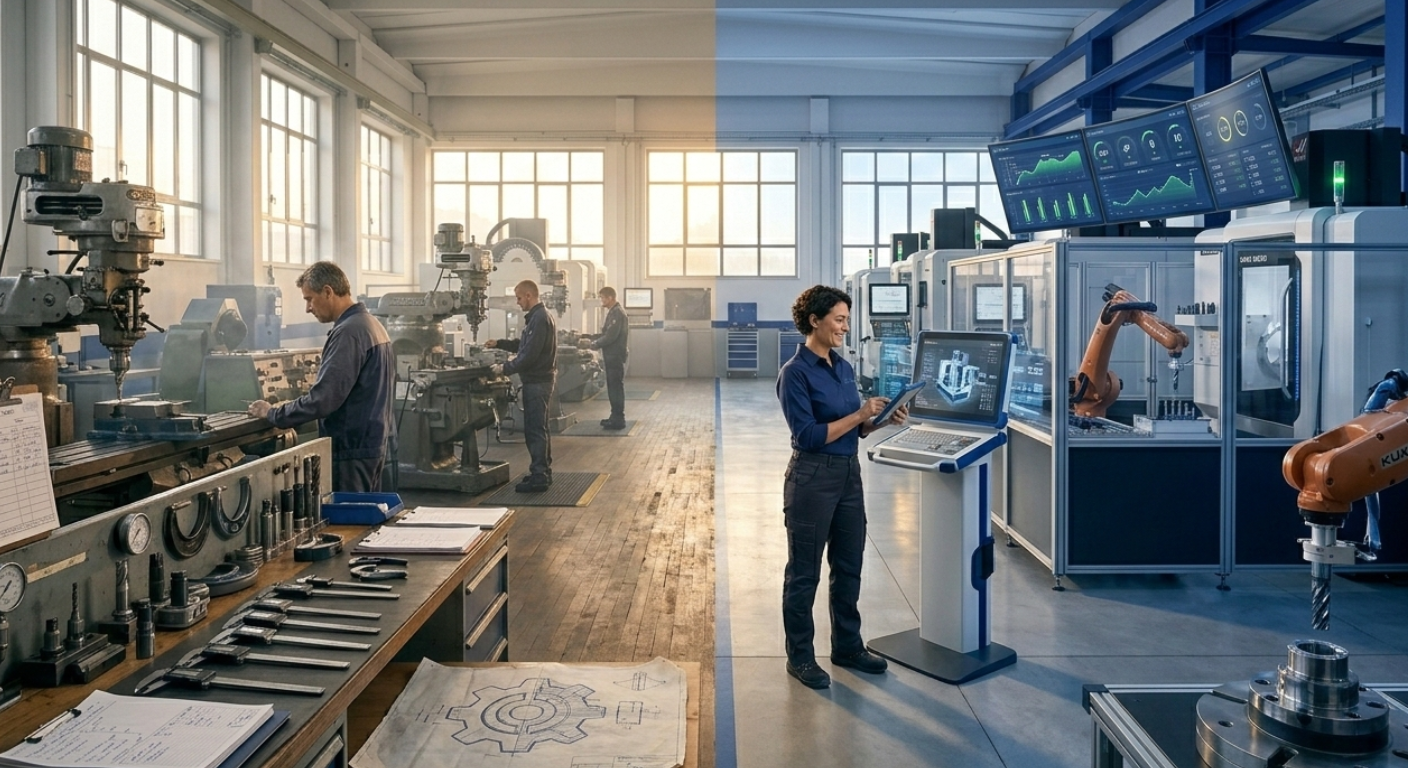
Featured Image Prompt: A striking visual of a tooling factory transitioning from analogue to digital. The left half shows traditional manufacturing - manual gauges, paper drawings on clipboards, handwritten job tickets. The right half shows the same factory digitised - screens displaying real-time dashboards, robotic arms, digital twin overlays on machines. A clear dividing line runs down the centre. Dramatic side-lighting, high contrast, editorial photography style.
"Digital transformation" has become one of the most overused phrases in manufacturing. It conjures images of massive IT projects, seven-figure consulting engagements, and 18-month implementation timelines. For many tooling manufacturers, it feels like something that happens to large corporations - not to a 50-person shop making cutting tools.
But digital transformation doesn't have to mean ripping everything out and starting again. The most successful transformations in tooling manufacturing are pragmatic, phased, and ROI-driven from day one.
Why tooling manufacturers need digital transformation now
The tooling industry faces converging pressures that make digital adoption a necessity rather than a choice:
- Customer expectations - OEMs and distributors expect digital catalogues, instant quotes, and online ordering
- Margin pressure - Raw material costs are volatile, competition is global, and customers have more pricing visibility than ever
- Labour challenges - Experienced estimators and engineers are retiring, and their knowledge isn't documented anywhere
- Speed requirements - The quote-first-wins dynamic is becoming more pronounced every year
"By 2027, 75% of manufacturing companies that fail to adopt digital processes will lose market share to digitally enabled competitors. The window for gradual adoption is closing." - World Economic Forum, Manufacturing Transformation Report
A practical four-phase roadmap
Phase 1: Digitise your quoting (Months 1-3)
Why start here: Quoting is the revenue engine. Improving it delivers measurable ROI faster than any other initiative.
What to do:
- Implement a CPQ platform designed for manufacturing
- Configure your top 5 product families with rules and pricing logic
- Set up professional quote templates
- Train your sales team on the new system
Expected outcomes:
- 60-80% reduction in quote turnaround time
- Consistent pricing across all sales channels
- Quoting knowledge preserved in the system, not just in people's heads
"We started our digital transformation with quoting because it was the one area where we could see ROI in weeks, not years. Within two months, our quote volume was up 45% and our win rate improved." - Managing Director, UK tooling manufacturer
Phase 2: Connect your data (Months 3-6)
Why this comes second: Once your CPQ system is generating structured quote data, you have a foundation to build on.
What to do:
- Integrate CPQ with your ERP system for real-time material costs and inventory
- Connect to your CRM for customer pricing history and account management
- Set up automated reporting on quoting metrics (win rate, turnaround, margin)
- Establish a single source of truth for product data
Expected outcomes:
- Quotes always reflect current material costs
- Customer-specific pricing applied automatically
- Management visibility into quoting performance
Phase 3: Enable self-service (Months 6-12)
Why this matters: Once your product configuration and pricing logic is digital, you can extend it to customers.
What to do:
- Launch a customer-facing portal for standard product configuration and quoting
- Implement online ordering for repeat and standard products
- Add real-time stock availability and lead time information
- Enable customer account management with quote history and order tracking
Expected outcomes:
- 24/7 quoting capability without adding staff
- Reduced load on inside sales for standard enquiries
- Improved customer experience and retention
"Our customer portal now processes 30% of our order volume. Customers love the convenience, and our sales team can focus on the complex, high-value work that actually needs human attention." - Commercial Director, European cutting tool company
Phase 4: Optimise with data (Months 12-18)
Why this is last: Optimisation requires data, and Phases 1-3 generate the data you need.
What to do:
- Analyse quoting data to identify pricing optimisation opportunities
- Implement predictive analytics for demand forecasting and pricing
- Use win/loss data to refine competitive pricing strategies
- Automate routine decisions (standard discounts, fast-track approvals)
Expected outcomes:
- Data-driven pricing decisions replace gut feel
- Predictive demand insights improve production planning
- Continuous improvement cycle established
Common pitfalls to avoid
Trying to do everything at once
The biggest killer of manufacturing digital transformation is scope creep. Stick to the phased approach. Each phase should deliver standalone value.
Choosing generic tools
A CRM-attached CPQ that works for software sales won't work for tooling manufacturing. Choose tools designed for your industry - ones that understand BOMs, machine time, material costs, and manufacturing constraints.
Neglecting change management
Technology is the easy part. Getting your team to adopt new tools requires training, support, and visible leadership buy-in. Budget 30% of your implementation effort for change management.
"We've seen digital transformation projects fail not because of technology, but because of culture. The companies that succeed are the ones where leadership actively uses the new tools and champions the change." - Deloitte, Manufacturing Digital Transformation Study
Over-customising
The temptation to customise every feature to match your current process is strong. Resist it. Modern platforms work best when you adapt your process to best practices rather than forcing the software to replicate your existing workflow.
The cost of waiting
Every month without CPQ is another month of:
- Quotes lost to faster competitors
- Pricing errors eroding margins
- Knowledge trapped in individual's heads
- Management decisions made without data
The tooling manufacturers who start this journey now will have a compounding advantage over those who wait. The technology is proven, the implementation paths are well-defined, and the ROI is measurable from the first phase.
Kabaido is the starting point for digital transformation in tooling manufacturing. Our CPQ platform gives you Phase 1 results within weeks - faster quotes, better pricing, and a foundation for everything that follows. Start your transformation or talk to our team.